





Derivative Market Intelligence
VIX Spot Price
Change
Strike
ExpiryInvalid DateTime
Most Active Calls
Strike
ExpiryInvalid DateTime
Most Active Puts
The Cboe Volatility Index® (VIX® Index) is a leading measure of market expectations of near-term volatility conveyed by S&P 500 Index®(SPX) option prices. Since its introduction in 1993, the VIX® Index has considered by many to be the world’s premier barometer of investor sentiment and market volatility.
Data as of 9:15 PM 12/12/2025
All share and notional values delayed at least 20 minutes
52 Week
Explore specifications, methodologies and other materials for optimal use of the VIX Index.
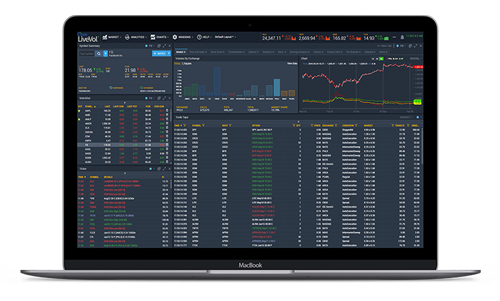
Get analysis on VIX Options and the rest of the U.S.-listed options market with Cboe LiveVol analytics platforms. LiveVol's web-based platforms provide everything you need to quickly analyze trading activity and identify opportunities.
View tutorials and take a free trialVIX futures and options have unique characteristics and behave differently than other financial-based commodity or equity products. Understanding these traits and their implications is important. VIX futures and options may provide market participants with flexibility to hedge a portfolio, employ strategies in an effort to generate returns from relative pricing differences, or express a bullish, bearish or neutral outlook for broad market implied volatility.
One of the biggest risks to an equity portfolio is a broad market decline. The VIX Index has had a historically strong inverse relationship with the S&P 500® Index. Consequently, a long exposure to volatility may offset an adverse impact of falling stock prices. Market participants should consider the time frame and characteristics associated with VIX futures and options to determine the utility of such a hedge.
VIX futures provide a pure play on the level of expected volatility. Expressing a long or short sentiment may involve buying or selling VIX futures. Alternatively, VIX options may provide similar means to position a portfolio for potential increases or decreases in anticipated volatility.
Over long periods, index options have tended to price in slightly more uncertainty than the market ultimately realizes. Specifically, the expected volatility implied by SPX option prices tends to trade at a premium relative to subsequent realized volatility in the S&P 500 Index. Market participants have used VIX futures and options to capitalize on this general difference between expected (implied) and realized (actual) volatility, and other types of volatility arbitrage strategies.
One of the unique properties of volatility – and the VIX Index – is that its level is expected to trend toward a long-term average over time, a property commonly known as "mean-reversion." The mean reverting nature of volatility is a key driver of the shape of the VIX futures term structure and the way it can move in response to changes in perceived risk. CFE lists nine standard (monthly) VIX futures contracts, and six weekly expirations in VIX futures. As such, there is a wide variety of potential calendar spreading opportunities depending on expectations for implied volatility.
Learn MoreStay current with timely market overviews, expert commentary, and best‑in‑class techniques for navigating the VIX Index.

Following this weekend’s strikes by the US, oil markets remain fairly stable as investors wait for Iran’s response. WTI 1M implied volatility surged to as high as 68% last week before ending the week at 51%. The WTI 1M implied-realized vol spread has halved from a high of 30 pts to 14 currently, as fears of significant oil supply disruption have abated somewhat. Notably, US inflation expectations have barely budged on this latest jump in oil prices, in sharp contrast to the 2022 Russia/Ukraine invasion.

Henry Shwartz, Vice President, Client Engagement, provides insight into recent options market activity.
An easy-to-read guide for understanding the VIX complex. This document provides investors with simple guidelines that translate VIX Index levels into potentially more meaningful predictions or measures of market sentiment.
Download WhitepaperA research paper outlining the opportunities created by using market uncertainty. This paper explains how the strategy of selling volatility has generated higher returns with smaller losses, compared with traditional equity portfolios.
Download Whitepaper