











Global Markets
Tradable Products
Featured Products

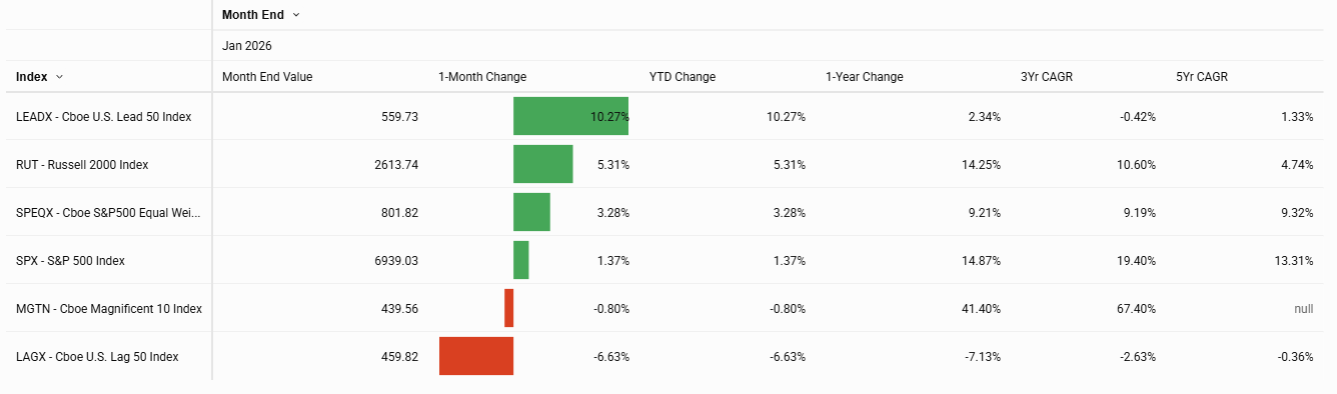
Broad‑based indices moved higher to start 2026, with small caps setting the pace as investors shifted their focus away from the high‑cap technology “Mag 10” stocks that had significant gains in 2025. For the month, the Russell 2000 ® Index (RUT) increased 5.31%, followed by the S&P 500 ® Equal Weight Index (SPEQX), which was up 3.28%, and the benchmark S&P 500 Index (SPX), which rose 1.37%.
Illustrating the shift, the Cboe Magnificent 10 (MGTN) Index declined 0.8%, while the Cboe U.S. Lead 50 Index (LEADX) — highlighting performance of the 50 top performers — gained nearly 10.3%. In contrast, the Cboe U.S. Lag 50 Index (LAGX), comprised of the worst‑performing stocks, fell 6.6%.
Following a relatively quiet holiday period, implied volatility finished the month well above muted year‑end levels, with the Cboe Volatility Index ® (VIX) closing at 17.44, 2.5 points higher month-over-month.
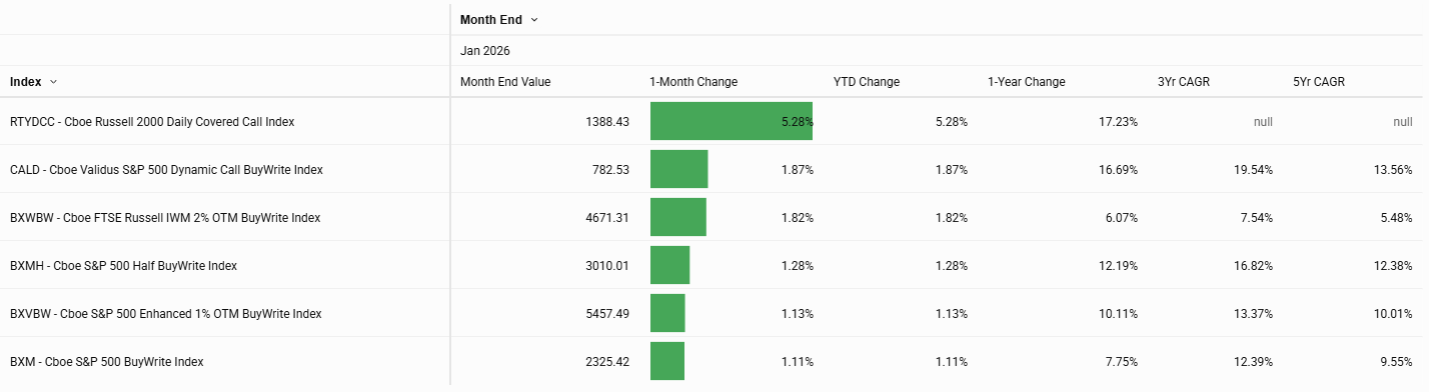
Among indices featuring call‑writing, higher premiums combined with mixed underlying moves led to gains for most indices, including the Russell 2000 Daily Covered Call Index, which was up 5.28%, and the Cboe Validus S&P 500 Dynamic Call BuyWrite Index (CALD), which rose 1.87%. Put‑writing indices were also higher on the month, with both PUTR and PUTD gaining nearly 1.5%.
Fixed income indices saw moderate gains, led by the Cboe HYG BuyWrite Index (BXHB), up 0.78%, and the Cboe LQD BuyWrite Index (BXLB), up 0.5%. Target outcome indices — the Cboe S&P 500 Enhanced Growth Index Series (SPEN) and the Cboe S&P 500 Buffer Protect Index Series (SPRO) — also posted gains near 1%.
Weakness was evident in the crypto segment, with the Cboe Bitcoin U.S. ETF Indices (CBTX and MBTX) both down more than 4%.
Source: Cboe
The Cboe S&P 500® Index option contract, known by its symbol SPX, is designed to track the underlying S&P 500 Index and help investors achieve broad market protection. SPX® options offer the potential opportunity to manage large-cap U.S. equity exposure and execute risk management, hedging, asset allocation, and income generation strategies.
The Cboe S&P 500® Equal Weighted Index option contract, SPEQX, is the equal-weight version of the widely-used S&P 500 divided by 10.0. The index includes the same constituents as the capitalization weighted S&P 500, but each company in the S&P 500 Equal Weight Index is allocated a fixed weight - or 0.2% of the index total at each quarterly rebalance. The Russell 2000 Index (RUT) measures the performance of small-cap segment of the U.S. equity universe. It is a subset of the Russell 3000® Index and includes approximately 2000 securities based on a combination of their market cap and current index membership. RUT options are valuable tools for increasing yields and managing risk.
The Cboe Magnificent 10 Index (MGTN) is an equal-weighted equity index designed to measure the price return of a select group of large-cap U.S. technology and growth-oriented companies with listed options. The Cboe U.S. Lead 50 Index measures the total return of the 50 best performing stocks, based on the total reinvested return of each Constituent Stock since the previous rebalance date, of the 100 Constituents Stocks in the Cboe U.S. Large-Mid Cap 100 Index (CEQX). The Cboe U.S. Lag 50 Index measures the total return of the 50 worst performing stocks, based on the total reinvested return of each Constituent Stock since the previous rebalance date, of the 100 Constituents Stocks in the Cboe U.S. Large-Mid Cap 100 Index (CEQX).
Source: Cboe
The VIX Index is based on real-time prices of options on the S&P 500® Index (SPX) and is designed to reflect investors' consensus view of future (30-day) expected stock market volatility. Cboe 1-Day Volatility Index® (VIX1D Index) estimates expected volatility by aggregating the weighted prices of P.M.-settled S&P 500 Index (SPX) puts and calls over a wide range of strike prices. The Cboe 3-Month Volatility IndexSM (VIX3M) is designed to be a constant measure of 3-month implied volatility of the S&P 500® (SPX) Index options.
Source: Cboe
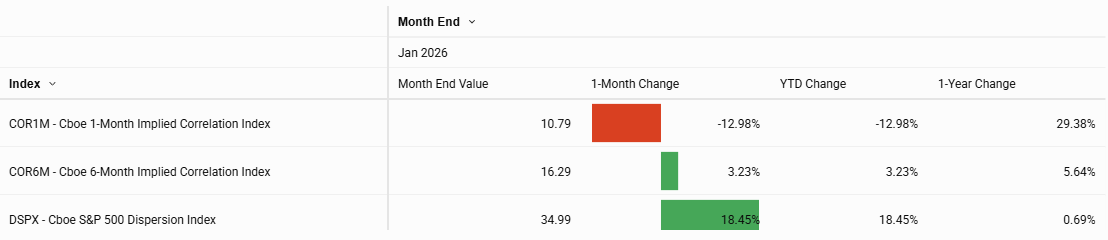
The Cboe S&P 500 Dispersion Index (DSPX) measures the expected dispersion in the S&P 500® over the next 30 calendar days, as calculated from the prices of S&P 500 index options and the prices of single stock options of selected S&P 500 constituents, using a modified version of the VIX® methodology. The Cboe S&P 500 Implied Correlation Indices including COR1M and COR6M are the first widely disseminated, market estimates of the average correlation of the stocks that comprise the S&P 500® Index (SPX). The Cboe S&P 500 Implied Correlation Indexes offers insight into the relative cost of SPX options compared to the price of options on individual stocks that comprise the S&P 500.
Source: Cboe
The Cboe® MSCI Emerging Markets BuyWrite Index (BXEF) is a benchmark index designed to track the performance of a hypothetical buy-write strategy on the MXEF® index. The Cboe S&P 500 BuyWrite Index(BXM) is a benchmark index designed to track the performance of a hypothetical buy-write strategy on the S&P 500 Index®.
The Cboe S&P 500 Half BuyWrite Index (BXMH) is a benchmark index designed to track the performance of a hypothetical covered call strategy. The BXMH Index is similar in design to the Cboe S&P 500 BuyWrite Index (BXM). However, the difference in methodology is as follows: the strategy only writes half a unit of an ATM monthly SPX Call option while the long SPX Index position remains unchanged. The Cboe Validus S&P 500® Dynamic Call BuyWriteSM Index (CALD) tracks the value of a hypothetical rules based investment strategy which consists of overlaying a basket of S&P 500 a.m.-settled standard expiry short call options over a long position invested in the S&P 500 with dividends reinvested (total return).
Source: Cboe
The Cboe S&P 500 PutWrite Index (PUT) tracks the value of a hypothetical portfolio of securities (PUT portfolio) that yields a buffered exposure to S&P 500 stock returns. The PUT portfolio is composed of one- and three-month Treasury bills and of a short position in at-the-money put options on the S&P 500 index (SPX puts). The number of puts sold is selected to ensure that the value of the portfolio does not become negative when the portfolio is rebalanced.
The Cboe Validus S&P 500 Dynamic PutWrite Index (PUTD) is designed to track the value of a rule-based investment strategy which consists of overlaying a basket of S&P 500 (SPX) a.m. settled standard-expiry short put options over a money market account invested at the 4-week daily Treasury Bill rate. The Cboe Russell 2000 PutWrite Index(PUTR) tracks the value of a hypothetical portfolio of securities (PUTR portfolio) that yields a buffered exposure to Russell 2000® stock returns. The PUTR portfolio is composed of an investment of $K in one-month Treasury bills and of a short position in an at-the-money puts on the Russell 2000 Index (RUT put), where K is the strike price of the put option.
Source: Cboe
The Cboe HYG BuyWrite Index (BXHB) is designed to track the performance of a covered call strategy with a short iShares iBoxx $ High Yield Corporate Bond ETF (HYG) Call option expiring monthly. The Cboe LQD BuyWrite Index (BXLB) is designed to track the performance of a covered call strategy with a short iShares iBoxx $ Investment Grade Corporate Bond ETF (LQD) Call option expiring monthly. The Cboe TLT 2% OTM BuyWrite Index (BXTB) is designed to track the performance of a covered call strategy with a short iShares 20+ Year Treasury Bond ETF (TLT) Call option expiring monthly.
Source: Cboe
The Cboe S&P 500 Enhanced Growth Index Series (SPEN) and Cboe S&P 500 Buffer Protect Index Series (SPRO)are part of a family of Target Outcome Indices. The Indices are designed to provide target outcome returns linked to the US domestic stock market. The Indices measure the performance of a portfolio of hypothetical exchange traded Flexible Exchange® Options ("FLEX® Options") that are based on the S&P 500® Index.
Source: Cboe
The Cboe VIX Tail Hedge Index (VXTH) tracks the performance of a hypothetical portfolio that -
Source: Cboe
Cboe Bitcoin U.S. ETF Index (CBTX) options and Cboe Mini Bitcoin U.S. ETF Index (MBTX) options offer tools to hedge, capitalize on price movements, or express directional views on the world’s largest cryptocurrency without holding the asset.
The information provided is for general education and information purposes only. No statement provided should be construed as a recommendation to buy or sell a security, future, financial instrument, investment fund, or other investment product (collectively, a “financial product”), or to provide investment advice. Past performance of an index or financial product is not indicative of future results.