Global Markets
Tradable Products
Featured Products
Global Clearing for Modern Markets
The Cboe Clear U.S. Rulebook outlines the rules and standards governing clearing operations, membership obligations, and regulatory compliance at Cboe Clear U.S.
Cboe Clear U.S. regulatory filings can be found on the Notices page below.
Cboe Clear U.S. Principles for Financial Market Infrastructures Disclosure
The options disclosure document for KPI Binary Options issued and cleared by Cboe Clear U.S.
Cboe Clear U.S., LLC (“CCUS” or the “Clearinghouse”) is registered with the Commodity Futures Trading Commission as a Derivatives Clearing Organization (“DCO”) and the Securities and Exchange Commission as a Covered Clearing Agency (“CCA”). CCUS’s governance arrangements support the public interest requirements in Section 17A of the Securities Exchange Act, support the objectives of its owners and participants, and place high priority on the safety and efficiency of the Clearinghouse by requiring all material risk issues to be addressed by its Risk Management Committee and Board of Directors.
The Board of Directors (“Board”) maintains primary oversight of the governance of CCUS, with its central objective being to promote the safety and efficiency of the Clearinghouse and to contribute to the overall stability of the broader financial system, while also taking into account the legitimate interests of key market stakeholders.
As part of fulfilling its oversight and governance responsibilities, the Board has established an Audit Committee, a Nominating Committee, and a Risk Management Committee to serve as advisory committees to the Board.
The Risk Management Committee will advise the Board with regard to any matters that could materially affect the risk profile of CCUS. To assist in fulfilling these responsibilities, the Risk Management Committee has also established the Default Management Committee to oversee CCUS’s default management process and its default management drills, and the Risk Advisory Working Group to provide risk-focused perspectives of market participants on matters that could materially affect the risk profile of CCUS.
The Audit Committee will provide independent and objective oversight of CCUS’s financial statement and financial reporting process, its systems of internal accounting and financial controls, its internal audit function, and the annual independent audit of CCUS’s financial statements. In this role, the Audit Committee assists the Board in overseeing the integrity of CCUS’s financial statements, compliance with legal and regulatory requirements as they relate to financial reporting, and the qualifications, independence, and performance of CCUS’s independent auditors. The Audit Committee also seeks to promote effective communication among the Board, management, internal audit, and the independent auditors.
The Nominating Committee is responsible for identifying, evaluating, and recommending to the Board qualified individuals for appointment as directors of CCUS. The Nominating Committee develops and maintains written policies, procedures, and fitness standards for evaluating the independence, fitness, and qualifications of director candidates. In doing so, it considers each candidate’s expertise and integrity, as well as the overall mix of skills and perspectives on the Board and the views of participants and other stakeholders.
The Risk Management Committee works in close coordination with the Board, and provides guidance on the Clearinghouse’s risk management oversight, including evaluating the effectiveness of CCUS’s overall risk management framework.
As part of its mandate, the Risk Management Committee advises the Board on any matter that could materially affect CCUS’s risk profile as a DCO and CCA. These matters include, but are not limited to:
The Default Management Committee (“DMC”) is responsible for managing risks to the Clearinghouse and its non-defaulting Clearing Members when a Clearing Member defaults, is at risk of defaulting, or when a non-default loss arises. The DMC’s responsibilities include:
The Risk Advisory Working Group (“RWG”) provides the Risk Management Committee with independent and informed risk-based input from the perspective of market participants regarding matters that could materially affect the risk profile of the Clearinghouse. The RWG must include at least two clearing member representatives and at least two representatives of customers of clearing members. This composition ensures that the RWG has the industry expertise needed to provide independent, knowledgeable input on matters that may materially affect the Clearinghouse's risk profile. Under its charter, RWG participants must act in a manner that supports the Clearinghouse’s safety and efficiency and contributes to the stability of the broader financial system.
Cboe Clear U.S., LLC (“CCUS” or the “Clearinghouse”) is a Delaware limited liability company and a wholly-owned subsidiary of Cboe Global Markets, Inc., a publicly-traded Delaware corporation based in Chicago, Illinois. CCUS is registered with the U.S. Commodity Futures Trading Commission (“CFTC”) as a derivatives clearing organization (“DCO”) and the Securities and Exchange Commission (“SEC”) as a covered clearing agency (“CCA”). The Clearinghouse’s primary regulators are the CFTC and SEC. CCUS operates under a U.S. legal framework comprised of the Commodity Exchange Act and regulations promulgated thereunder, the Securities Exchange Act and regulations promulgated thereunder, and the U.S. Bankruptcy Code.
Cboe Clear U.S. Disciplinary Notices will be located on the Notices page when they are actioned.
The Cboe Digital Exchange Rulebook describes the CFTC-regulated designated contract market ("DCM") organization, the obligations and responsibilities of Participants, and prohibited trading practices and conduct on the DCM, which involves trading of futures.
DownloadCboe Clear U.S. no longer conducts money transmission or related activity.
Questions? Please contact us at clearus.operations@cboe.com
If you wish to place a complaint with the Cboe Digital Market Regulation Department, please send an email to Digital.market.regulation@cboe.com and include the following information:
The information obtained from a complaint is confidential and will generally not be shared outside of the Market Regulation Department. Subject to the Exchange rules, and state and federal regulations, information related to the complaint may be shared with the CFTC or state regulatory agencies.
Cboe Digital no longer operates a spot digital asset market. All Cboe Digital licenses related to the operation of spot digital assets have been surrendered to applicable states.
If you have a question or complaint, please contact us at digital.market.regulation@cboe.com
For unresolved complaints, you may contact the relevant state agency for your state. You may also contact the Consumer Financial Protection Bureau at +1 855-411-2372 or www.consumerfinance.gov.
| Circular No. | Submission | Date |
|---|---|---|
| #24-01RC | Ownership and Control and Large Trader Reporting | January 24, 2024 |
| File No. | Submission | Date |
|---|---|---|
| URE-396-11 | Marex Capital Markets Inc. | April 9, 2025 |
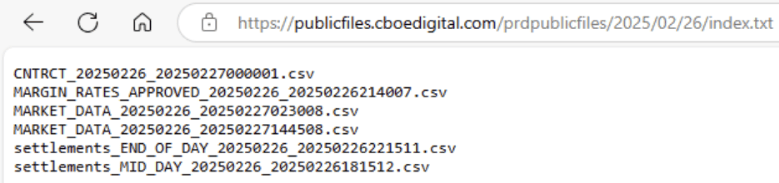
Steps to access historical daily statistics
https://publicfiles.cboedigital.com/prdpublicfiles/YYYY/MM/DD/index.txt
Example
Important Notes: