





Global Markets
Tradable Products
Featured Products

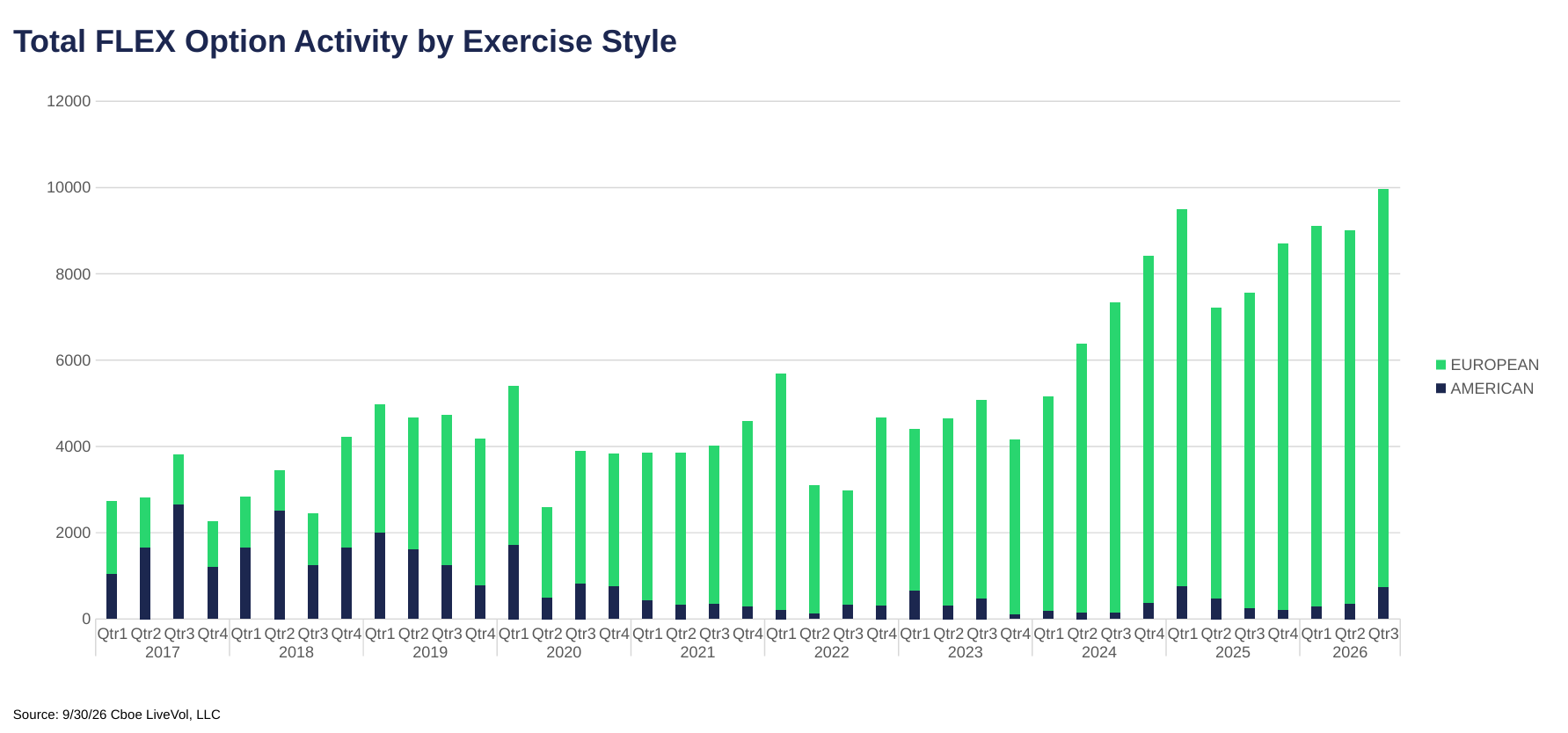
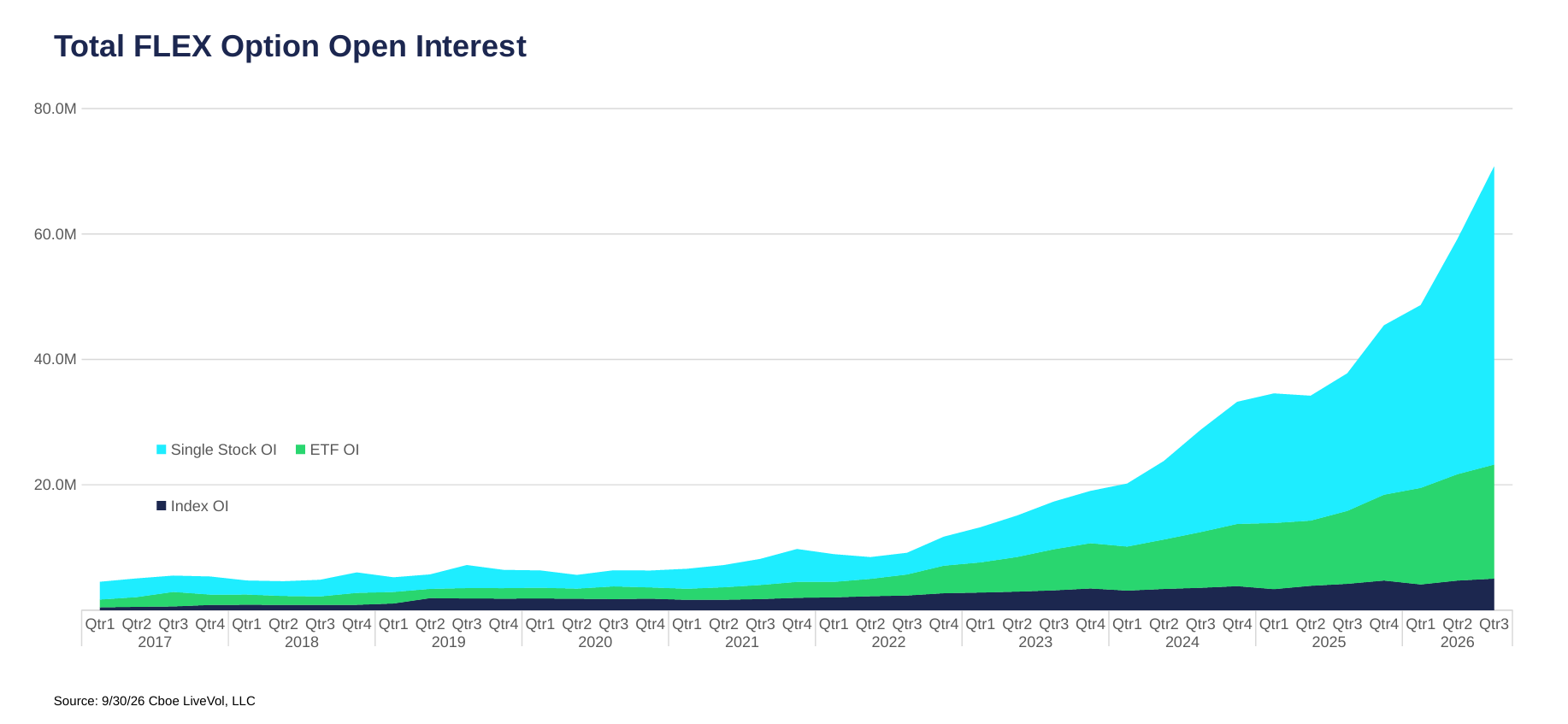
FLexible EXchange® (FLEX®) options were created more than 30 years ago as a customizable portfolio management tool allowing users to specify key contract terms, including exercise prices, styles (American or European style) and expiration dates on major indices. Over the last three decades, more and more traders have come to understand the utility of FLEX options, leading to record growth in recent years. FLEX options average daily volume reached a record 2.33 million contracts per day in the third quarter of 2026 and total open interest finishing above 71 million contracts — nearly 11 percent of the total options market.
Cboe pioneered FLEX options to meet the needs of institutional investors seeking greater precision than standard listed options could provide. And today, precision is more important than ever. These contracts make it possible to build similar payoffs to structured notes inside a centrally cleared framework, reducing counterparty risk. The combination of over-the-counter (OTC) style customization and exchange-grade safety turned FLEX Options from an underused tool into a driver of overall options volume.
Over the past decade, FLEX options activity has shifted almost entirely to European-style exercise style. In 2017 and 2018, American-style exercise style — meaning options can be exercised any time before expiration — made up roughly half or more of FLEX options activity. Since 2021, European style — meaning options can only be exercised at expiration — has accounted for well over 90% of activity. The increase in European style exercise coincides with the rise of defined outcome ETFs which rely on European exercise to keep their options packages intact for the full outcome period.
FLEX options open interest has increased significantly in recent years. Open interest remained under 10 million contracts for most of 2017 through 2022, then reached roughly 38 million contracts in the third quarter of 2025. A year later, in the third quarter of 2026, open interest had nearly doubled to about 71 million contracts. Single-stock FLEX options make up the largest share of that growth, at roughly two-thirds of the total, while ETF FLEX options open interest has also grown steadily and index FLEX options remain a smaller part of the total.
Single stock FLEX Options continue to dominate the overall FLEX options open interest. However, these options are currently settled by delivering shares of the stock. Now, issuers are eager for a pending SEC filing to allow cash-settled FLEX Options on single stocks.
This filing would amend certain rules to permit cash settlement for FLEX options on certain individual stocks that meet liquidity thresholds, with matching position and exercise limits. Only 39 ETFs met these thresholds in 2023, while 169 single stocks met them in the first half of 2026, highlighting the importance of allowing cash-settled FLEX options for single stocks. Cboe expects current users of OTC cash-settled single-stock options, such as hedge funds, prop firms and pension funds, to be among the main users.
The growth of FLEX options from around 8,000 contracts per day to a record 2.33 million contracts per day in 2026 underscores the increased demand for defined-outcome investment products. When the first defined-outcome ETF launched in 2018 and FLEX options gained more traction, this created a recurring demand for the product. Since then, liquidity providers have joined in on the momentum, ultimately becoming more comfortable with the product and leading to an overall rise in volume. Now, advancements in FLEX contracts — including automation and rule changes — make new defined-outcome strategies possible.
Automation, especially on quarterly roll days, is crucial for managing the workflow from start to finish. When hundreds of packages are coming in a short time frame, and each package has multiple options, liquidity providers are quoting upwards of a thousand options in that window. Now, some providers have set up quoting infrastructure to handle that volume. The automation replaces manual steps, bringing in the request and translating it into a format traders can price, checking it and sending the quote back to the broker, a process that would be more difficult without automation.
This advancement lets the defined-outcome space scale. Roll days can be more manageable, making it easier for more liquidity providers to compete, which can lead to tighter pricing. Technology can’t stop there. Further automation, possibly with how quotes are sent and received, can continue to strengthen and scale the defined-outcome space.
Similarly, new rule changes and enhancements to FIX Protocol can allow the defined-outcome market to scale. FIX Protocol is an electronic communications standard developed in the early 1990s to facilitate the real-time exchange of trading information between financial institutions. Currently, a typical options order or request for quote over FIX works by specifying the contract and negotiating on price. If a trader buys 10 SPY calls expiring on a specific date at specific strike, the terms are fixed and the price is the variable. Defined-outcome strategies do not negotiate this way. Buffer strategies have a fixed budget with the strike or cap as the variable, a type of negotiation that FIX does not support. For defined-outcome to truly scale FLEX, the FIX Protocol will need to be enhanced to create a more common language that encompasses defined-outcome positioning.
As defined-outcome investing expands to a wider array of underlying assets, market rules, technology and liquidity must keep up the pace and precision to move the industry forward.
There are important risks associated with transacting in any of the Cboe Company products discussed here. Before engaging in any transactions in those products, it is important for market participants to carefully review the disclosures and disclaimers contained at: https://www.cboe.com/global-disclaimers/. These products are complex and are suitable only for sophisticated market participants. In certain jurisdictions, Cboe Company products are only permitted for investment professionals, certified sophisticated investors, or high net worth corporations and associations. These products involve the risk of loss, which can be substantial and, depending on the type of product, can exceed the amount of money deposited in establishing the position. Market participants should put at risk only funds that they can afford to lose without affecting their lifestyle.