





Global Markets
Tradable Products
Featured Products

Crypto derivatives are moving into the regulated mainstream. Following the 2024 launch of spot Bitcoin ETFs, the CFTC approved Kalshi's Bitcoin perpetual futures contract on May 29, 2026 — the first time this once-exotic crypto product has landed on a regulated U.S. exchange. CFTC Chair Selig has signaled that approvals for other asset classes are likely to follow, and in a recent interview he compared perpetual futures to "zero day options." That comparison has prompted a wave of investor questions about how perpetual futures ("perpetuals") stack up against zero-day-to-expiration (0DTE) options. Cboe's latest Volatility Insights report argues the comparison, while understandable on the surface, breaks down once you look past leverage and into payoff structure, risk, and actual investor behavior.
Perpetual futures were conceived by economist Robert Shiller in 1992 as a way to create tradable markets for illiquid assets, but weren't launched until 2016, when BitMEX brought them to crypto markets. Unlike traditional futures, perpetuals never expire; a periodic funding-rate payment between long and short holders keeps the contract price anchored to spot. Roughly 90% of perp volume — about $230 billion in average daily notional last year — trades on centralized crypto exchanges.
0DTE options, by contrast, are simply options traded on their expiration day — a concept as old as listed options themselves (Cboe introduced them in 1973). What's new is the sheer number of expirations available. 0DTE trading has grown continuously since Cboe added Tuesday/Thursday expiries to the existing Monday/Wednesday/Friday weekly cycle for S&P 500 Index options (SPX®) in 2022, with average daily notional volume up reaching a record $2.3 trillion in the second quarter of 2026. 0DTE contracts now account for over 60% of all SPX options volume on a typical day.
Both products have grown quickly, draw heavy retail participation and offer embedded leverage. However, there are key differences that will keep traders from using perpetuals and 0DTE options to reach the same objectives.
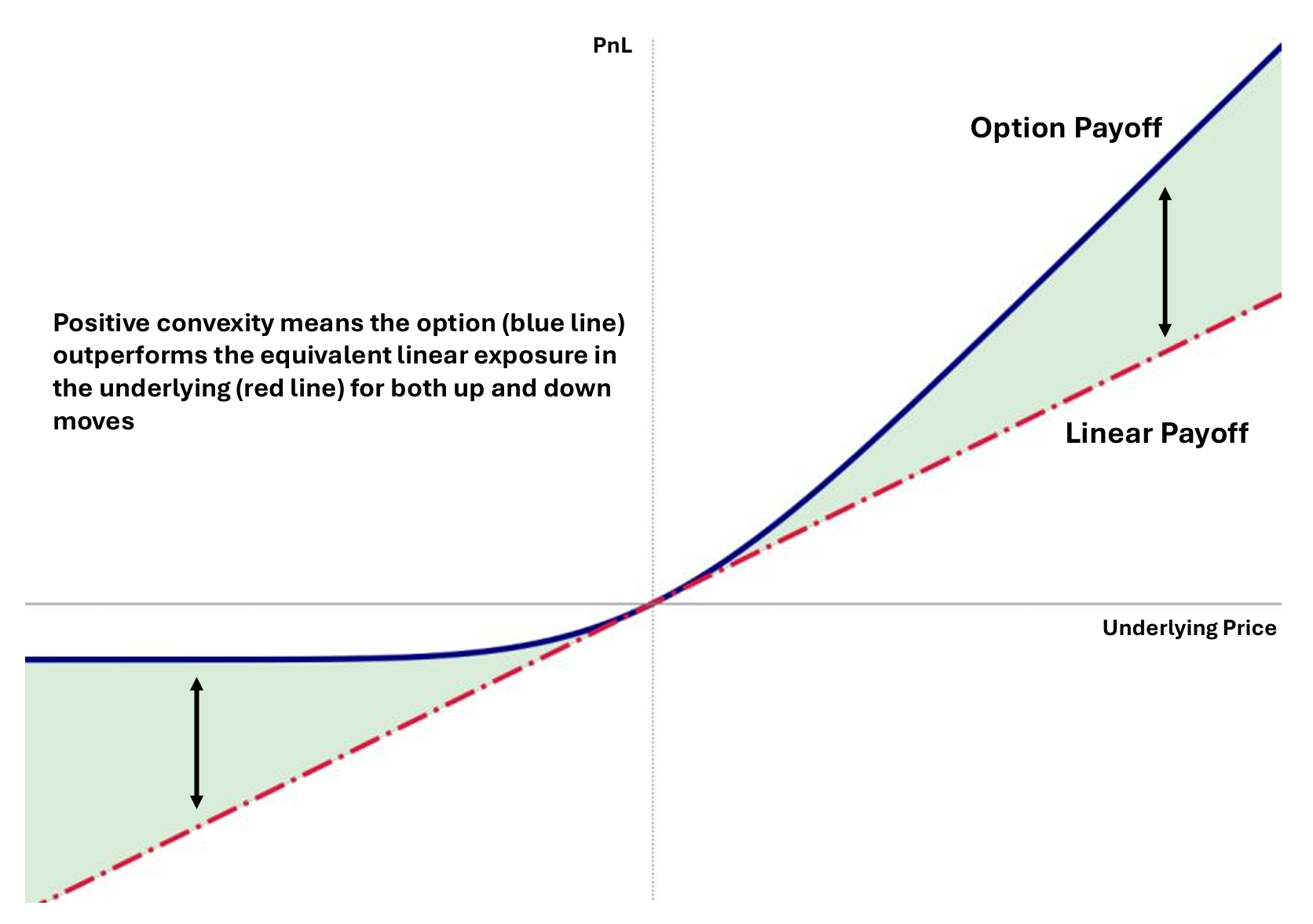
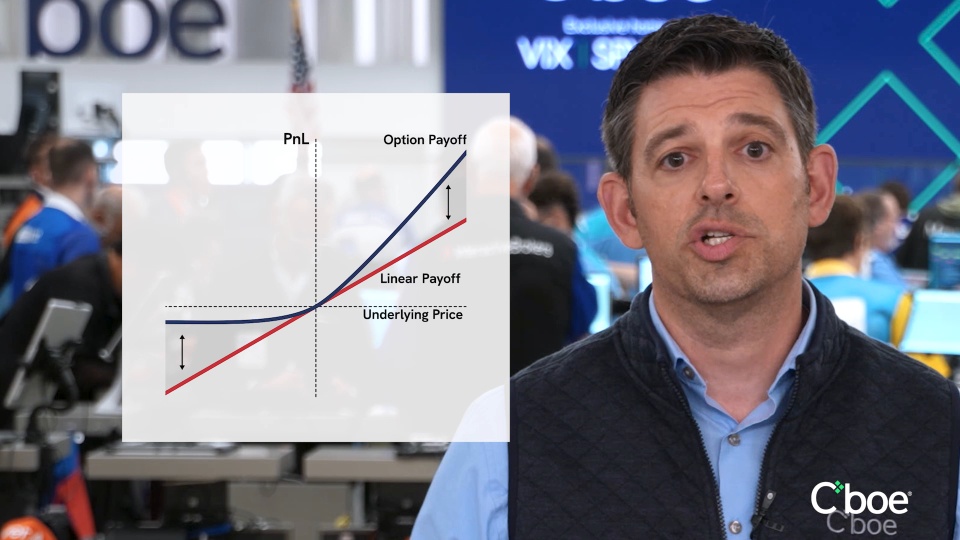
The most important distinction is structural. Perpetuals are linear instruments: a 1% move in the underlying produces a 1% move in the position (times leverage). Options are convex — as they move further in-the-money, their sensitivity to the price of the underlying asset increases, amplifying gains at an accelerating rate.
Take a look at this case study.
A stalled U.S.-Iran ceasefire negotiation triggered a 0.94% intraday SPX decline on April 21, 2026. A 10x leveraged short perpetual position, an at-the-money SPX 0DTE put, and an out-of-the-money 0DTE put were all sized to the same notional exposure.
The perpetual gained 9.4%. The at-the-money option gained 404% — a 42x better return — and the out-of-the-money option gained 617%, a 65x better return, while requiring far less capital upfront. Run the scenario in reverse, and the asymmetry is even starker: the perpetual would have lost the full 9.4% (linear losses mirror linear gains), while the two options would have lost only their premium — a small fraction of the perpetual's downside.
As perpetual futures gain traction, they shouldn't be mistaken for a stand-in for 0DTE options. Perpetuals are linear, primarily speculative instruments carrying real leverage, liquidation and funding-cost risks. SPX 0DTE options are convex instruments used across hedging, income generation and tactical trading, with the vast majority of activity structured to define risk upfront. 0DTE options trading has grown steadily through both calm and turbulent markets, while perpetuals activity rises in a bull market and pulls back in a bear market.
Cboe’s Market Intelligence team fully analyzes these differences in a recent research paper, titled Crossed Wires: Separating Perception from Reality. Download the paper to read the research.
There are important risks associated with transacting in any of the Cboe Company products discussed here. Before engaging in any transactions in those products, it is important for market participants to carefully review the disclosures and disclaimers contained at: https://www.cboe.com/global-disclaimers/. These products are complex and are suitable only for sophisticated market participants. In certain jurisdictions, Cboe Company products are only permitted for investment professionals, certified sophisticated investors, or high net worth corporations and associations. These products involve the risk of loss, which can be substantial and, depending on the type of product, can exceed the amount of money deposited in establishing the position. Market participants should put at risk only funds that they can afford to lose without affecting their lifestyle. © 2026 Cboe Exchange, Inc. All Rights Reserved.

