Implied volatilities were mixed across asset classes last week. While stocks rebounded, bonds sold off on higher real yields as the Fed turned more hawkish. A hike at the Dec FOMC meeting is now not only fully priced in, but investors are also pricing in a small probability (~7% in the OIS market) of a super-sized hike (i.e. 50bps). Despite higher yields, equity, credit, and oil implied volatilities all fell wk/wk.
Small caps felt the impact of higher rates more acutely than its large-cap counterparts, with the RTY-SPX 1M implied volatility spread rising from its 1-year low of 1.9% to 4.4% over the past week. Demand for protection in RTY also jumped sharply higher, with RTY 1M skew ending the week near a 1-year high. For more on the growth in the Russell 2000 derivatives ecosystem, including a deep dive into the drivers of small-cap relative performance and volatility, please see our latest report here.
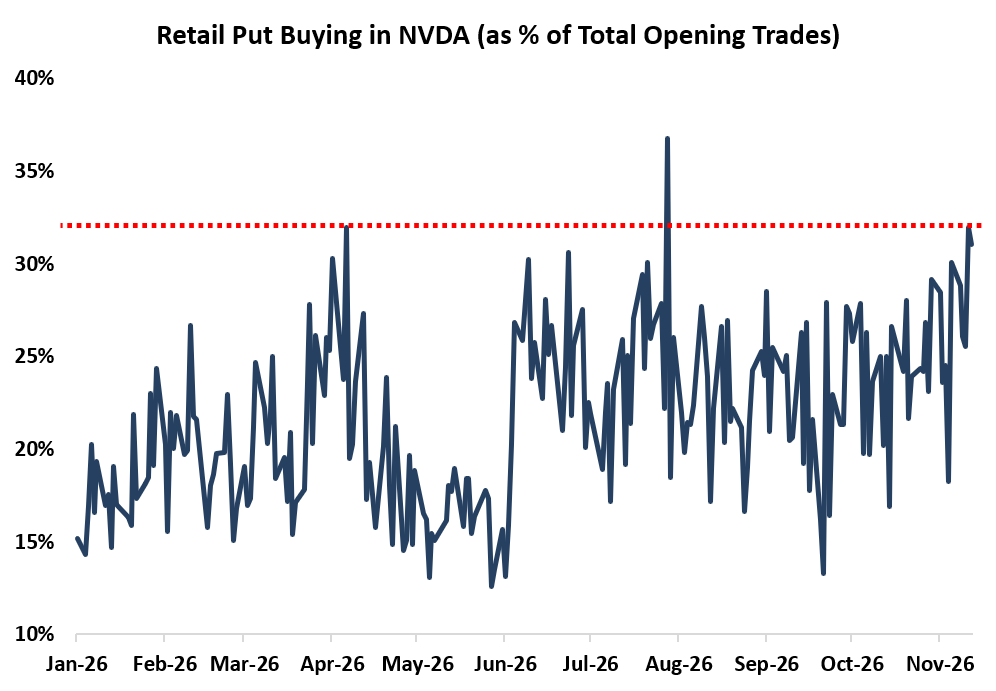
All eyes on NVDA earnings this Tuesday following the ouster of Jensen Huang. Options are implying a one-day move of 8% on earnings (vs. average realized move of 4.8% the past four quarters). Retail sentiment in the stock has turned more bearish over the past week. Looking at retail opening trades on Cboe's exchanges, we see a notable uptick in put buying in NVDA, which made up 32% of all opening trades on Thursday, over 10 pts higher than the YTD average of 21%. See chart below.
Chart: Retail Positioning in NVDA Options on Cboe's Exchanges