Small Caps, Mighty Liquidity: Inside the Russell 2000 Derivatives Ecosystem

Wei Liao
|
November 12, 2026

Executive Summary:

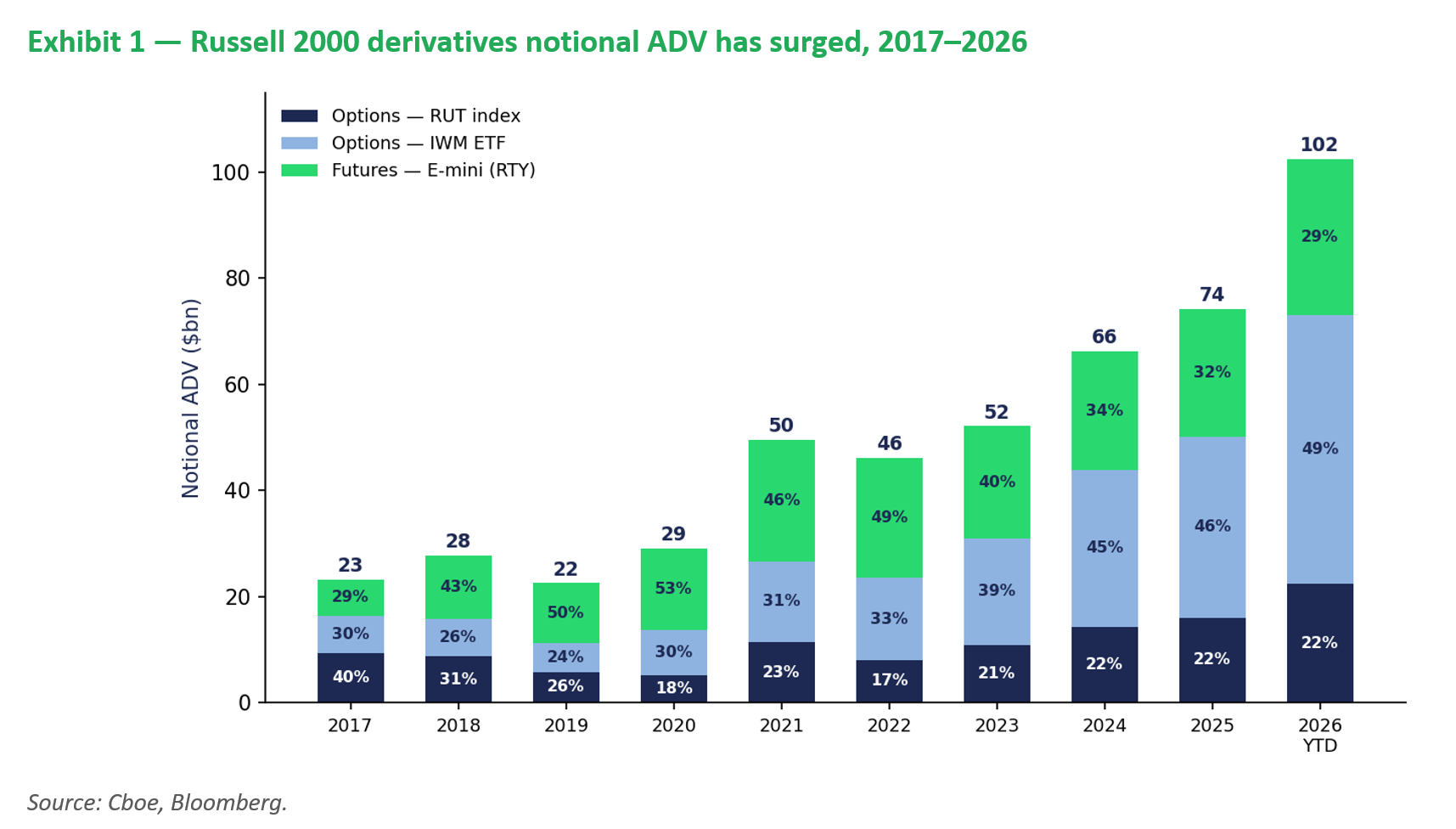
  • A large, liquid, and fast-growing market: The Russell 2000 index has been the standard gauge of US small caps since 1984 and the primary venue for investors to express, hedge, or monetize small-cap risk. In recent years, derivatives activity on the Russell 2000 Index has surged, with total derivatives notional ADV rising from $23B in 2017 to a record $102B year-to-date through September 2026 (see chart below). Growth has been particularly strong over the past two years, led by increased options volume, with RUT and IWM options now making up roughly three-quarters of the derivatives complex (up from 50% in 2022).
  • Retail and 0DTE options have been the growth engines: Between early 2023 and mid-2026, 0DTE accounted for roughly 58% of the increase in RUT options ADV and 77% of the increase in IWM options ADV. Retail represents about 60-65% of the 0DTE activity.
  • The growth challenges the stereotype that small-cap exposure is hard to trade: As ranked by their 2025 notional ADV, the Russell 2000 options liquidity is on par with the Euro STOXX 50 - the flagship large-cap index for Europe - and multiple times that of other developed countries' large-cap indices, including Germany (DAX), UK (FTSE 100), and Japan (Nikkei 225). Among global equity index benchmarks, only the S&P 500® Index and the Nasdaq-100 Index combine a deep options market with a comparably large benchmark asset base.
  • Common use cases for Russell 2000 options: The report explores how RUT options can be used for income, hedging, relative value, event, and macro trading. A joint FTSE Russell-Cboe study found that RUT put spread overlays cushioned most of the largest private equity drawdowns from 2007 to 2023.
  • Small cap "underperformance" is largely a concentration story: The Russell 2000 Index has trailed the S&P 500 Index, but since 2015 its return (8.0% a year) has been much closer to the equal-weight S&P 500 Index (8.9%) than to the cap-weighted index (11.8%). That suggests the gap is more a reflection of mega-cap concentration than size. We also explore 2026's reversal in small-cap outperformance and the index's sensitivity to the macro cycle. For more, see full report here.

[Download Full Report Here]

[Subscribe Here]

Article Tags:
Small Caps, Mighty Liquidity: Inside the Russell 2000 Derivatives Ecosystem | Cboe