Cross-asset implied volatilities declined across the board on the back of a run of “goldilocks” inflation prints (soft CPI, flat PPI) that has reinforced hopes the Fed is done hiking. Despite the retracement of 30-year Treasury yields to 10-year highs, interest rate volatility as measured by the MOVE Index continues to edge lower and is now trading at 36th percentile lows vs 89th percentile highs 2-weeks ago. (Although the MOVE Index is calculated as a blend of 2, 5, 10 and 30-year swaption volatility, it is most sensitive to front-end and belly uncertainty tied to near-term Fed decisions. The disconnect between the two measures suggests that short-end rate expectations and marginal policy uncertainties have stabilized while the long end has remained elevated for structural reasons (e.g., term premium, supply). The odds of a Sept hold = 67%.
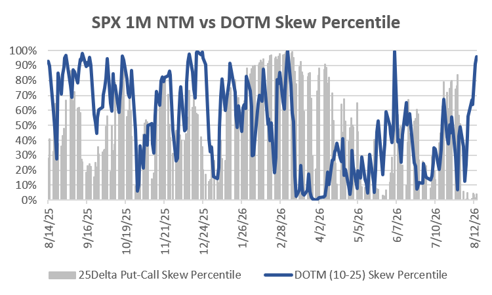
The VIX® Index underperformed skew last week, falling -0.65 pts to 14.25 (a YTD low) due primarily to a lowering of fixed-strike vols across the curve. Although the benign inflation backdrop has anchored skew to its lowest levels since mid-2024, deep OTM puts continue to be bid with SPX 1M put convexity (10-delta vs 25-delta put ratio) trading at 92nd percentile highs over the last year. We believe the demand for DOTM puts is an opportunistic play with traders taking advantage of vol-of-vol at 2-year lows (VVIX=87) to pre-emptively accrue long downside convexity hedges rather than positioning for a specific downside catalyst.
Chart: Traders Taking Advantage of “Cheap” Convexity Premia to Hedge Downside Tail-Risk