






Market Research
Since being pioneered by Cboe Europe in 2015, Periodic Auctions have become a well-established part of the European equities trading ecosystem.
Today, Periodic Auctions represent approximately 13% of continuous trading in European equities, with Cboe operating the largest venue and accounting for 76% of total activity in the segment as of October 2026.
This growth reflects their effectiveness at executing client orders with minimal market impact while providing opportunities for price and size improvement. Through their discontinuous nature and introduction of randomness into the timing of the uncross, Periodic Auctions can help participants access liquidity efficiently. As activity has grown, and the number of operators has increased, more attention has been paid to how the quality of liquidity has evolved.
Cboe Europe's Execution Consulting team recently published new research, ‘Liquidity, Success Rates and Mark-Outs: An Evolving Picture in European Periodic Auctions’, examining some of these developments in more detail. The paper highlights how Cboe Periodic Auction success rates have remained high and stable over the past two years, demonstrating the venue's ability to maintain effective matching as activity has grown. In addition, venue-level mark-out analysis over recent months indicates that Cboe has outperformed competing Periodic Auction MTFs in major index constituents.
A selection of insights is included below. To receive a copy of the full paper, please contact your account manager or email us at saleseurope@cboe.com.
One of the metrics commonly used to measure execution quality in Periodic Auctions is the success rate, or the proportion of triggered auctions that result in a trade.
Success rates have featured in recent papers from other trading venues, but the comparisons have not always been made on a like-for-like basis. Differences in auction design, particularly around the publication of indicative price and size information during the call period, can materially affect how success rates are measured and should be taken into account when comparing venues. Some venues publish all indicative price and size prints, including when only a single order is present and no execution is possible, resulting in zero indicative price and size prints. Others start publishing indicative and size data when matching interest exists, omitting zero prints. As a result, headline success rates can vary significantly depending on the methodology used.
For meaningful venue comparisons, Cboe defines Periodic Auction success rates as the number of uncrossed (traded) auctions divided by the number of triggered auctions. A triggered auction is one in which a marketable order is present and executable interest exists on the contra side, resulting in a non-zero indicative price.
Defined this way, the success rate reflects how auctions behave once there is something to match and is not affected by growth in auctions opened by single orders.
Source: Cboe
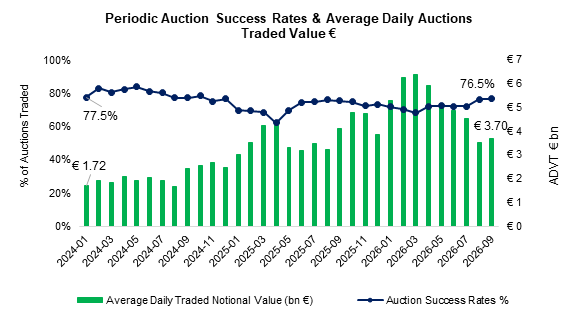
The chart above shows the percentage of triggered auctions that resulted in a trade on Cboe Periodic Auctions, alongside ADVT. Despite a substantial increase in auction activity, the Cboe Periodic Auction success rate has remained high and stable, standing at 76.5% in September 2026 compared with 77.5% at the start of 2024.
As the chart above shows, ADVT in Cboe Periodic Auctions has risen to €3.7bn in September 2026, giving participants access to a deep pool of liquidity. One measure of that liquidity is how often an auction attracts additional interest once it has started. As previously discussed, an auction is triggered by initial matching interest; if the indicative size then increases before the randomised uncross occurs, the venue has drawn further orders into the auction.
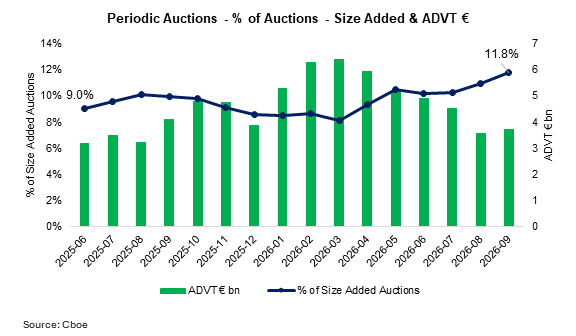
The chart below shows the percentage of auctions in which this occurs. A high percentage indicates that Cboe's pre-trade market data updates are successfully attracting participation. The proportion of auctions in which additional size was added increased to 11.8% in September 2026, up from 9.0% a year earlier, demonstrating Cboe's growing ability to attract incremental liquidity into active auctions and create more matching opportunities for participants.
Periodic auctions have been proven to consistently deliver lower mark-outs than other on-venue execution mechanisms. Independent price formation and randomised end times reduce opportunities for latency arbitrage, helping to explain their superior mark-out performance.
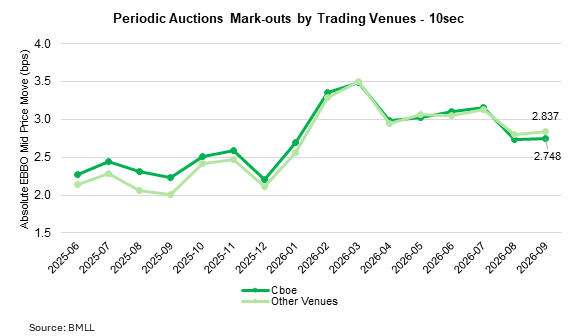
Although market-wide mark-out profiles have evolved in recent months, Cboe has outperformed competing Periodic Auction MTFs on post-trade mark-outs since July 2026. This outperformance is particularly significant given that Cboe represents 76% of total Periodic Auction ADVT and consequently facilitates a much broader range of trading interests than its peers.
As the chart below illustrates, the gap widened further in September 2026 for large-cap constituents of the major European indices, reinforcing the quality of the liquidity available in Cboe Periodic Auctions.
© 2026 Cboe Exchange, Inc. All rights reserved.
The information provided is for general education and information purposes only. No statement provided should be construed as a recommendation to buy or sell a security, future, financial instrument, investment fund, or other investment product (collectively, a “financial product”), or to provide investment advice.