Global Markets
Tradable Products
Featured Products

As shown in the table below, in the six quarters in which the S&P 500 fell by more than 13.8%, most of the Cboe indices did not have losses as severe as those of the S&P 500 Index. Because many of the Cboe indices track strategies that purchase index options on a certain day of the month, there is some path dependency and variability in their performance over various time periods.
| 3Q2001 | 3Q2002 | 4Q2008 | 3Q2011 | 1Q2020 | 2Q2022 | |
|---|---|---|---|---|---|---|
| VXTH℠ - Cboe VIX Tail Hedge Index | n/a | n/a | 0.2% | -6.8% | 54.9% | -18.2% |
| PPUT℠ - Cboe S&P 500 5% Put Protection Index | -4.1% | -9.1% | 0.2% | -8.0% | 0.0% | -13.1% |
| CLL℠ - Cboe S&P 500 95-110 Collar Index | -0.7% | -8.1% | -5.9% | -11.6% | -5.0% | -6.7% |
| S&P 500® Index | -14.7% | -17.3% | -21.9% | -13.9% | -19.6% | -16.1% |
| Total return (pre-tax) Indices. Source: Cboe Global Indices | ||||||
Asset Consulting Group
A goal for the purchase of cash-settled stock index protective put options often is to hedge a price drop in the stock index.
A stock index protective put position can be created by (1) owning or buying a portfolio of stocks, and (2) buying corresponding stock index put options to hedge some of the downside risk of the stock portfolio.
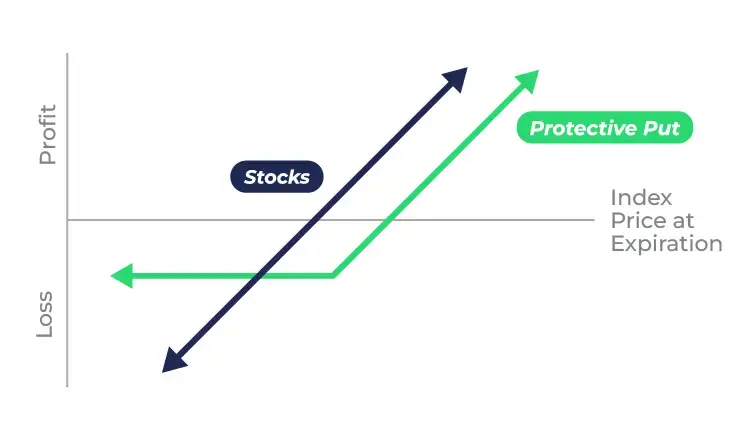
The stock index protective put is designed to limit downside risk and establish a floor price, with the upside being potentially unlimited, after factoring in the premium and commission costs. To mitigate the net upfront costs for options premiums, the features of the protective put could be compared with the collar strategy.
There are important risks associated with transacting in any of the Cboe Company products or any digital assets discussed here. Before engaging in any transactions in those products or digital assets, it is important for market participants to carefully review the disclosures and disclaimers contained here. These products and digital assets are complex and are suitable only for sophisticated market participants. These products involve the risk of loss, which can be substantial and, depending on the type of product, can exceed the amount of money deposited in establishing the position. Market participants should put at risk only funds that they can afford to lose without affecting their lifestyle.