Retail Price Improvement
Retail Price Improving (RPI) orders are available on EDGX and BYX. RPI orders offer
price improvement in $0.001 increments to Retail Member Organizations (RMOs) that enter
a Retail Order (RO). For liquidity providers, RPI orders provide continuous access to
high-quality retail flow that is unavailable elsewhere. Liquidity providers can
passively capture marketable retail demand throughout the trading day, and avoid trading
with non-Retail liquidity-seeking orders. Retail orders executing against RPI orders
benefit from price improvement. For details on the offering for each market, read more
below:
Cboe EDGX Retail Price Improvement
Effective April 10, 2026, EDGX Exchange Members may input Retail Price Improving (RPI)
orders on the EDGX Exchange order book that will offer price improvement in $0.001 to
increments to Retail Member Organizations (RMOs) that enter a Retail Order (RO).
The primary differentiator between the RPI program on BYX and the new RPI program on
EDGX is that Retail Orders entered on EDGX may use a time-in-force other than Immediate
or Cancel (“IOC”), allowing these Retail Orders to post to the EDGX Book. The RPI Order
will only be permitted to execute against incoming Retail Orders and will not be
eligible to remove resting Retail Orders from the EDGX Book. Additionally, Members will
have the option to enter their RPI Orders with MidPoint Peg instruction.
How it Works
-
Retail Price Improvement (RPI) Orders are submitted by liquidity adders that
offer price improvement over the National Best Bid or Offer (NBBO) in minimum $0.001
increments. RPI orders only interact with Retail Orders.
-
A Retail Liquidity Indicator (RLI) message will be disseminated on PITCH and
SIP feeds when there is a Retail Price Improvement (RPI) order present for a symbol
on the EDGX Exchange order book or to indicate a RPI order is no longer available.
-
Retail Member Organizations (RMOs) can choose from three types of interactions:
- Interact with Price Improving Orders Only (book only)
- Interact with Price Improving Orders and the far touch (book only)
-
Interact with Price Improving Orders, the far touch and route out (routable)
Technical Information
Retail Price Improving (RPI) Orders
Any EDGX Exchange Member may enter RPI orders in $.001 increments. RPI orders are only
accessible to Retail Orders. No other order type will interact with an RPI order.
RPI orders may be entered in $0.001 increments by any EDGX Exchange Member as follows:
-
Retail Price Improving order:
- Must set RoutingInst (9303) = ‘B’ or ’ P’
- Must set ExtendedExecInst (9416) = ‘T’ (Retail Price Improving order)
-
DisplayIndicator (9479) = ‘I’ (Invisible) is implied but, like peg orders,
not required; any other values for DisplayIndicator will be rejected.
-
Retail Price Improving Peg order:
- Must set RoutingInst (9303) = ‘B’ or ’ P’
- Must set ExtendedExecInst (9416) = ‘T’ (Retail Price Improving order)
- Must set ExecInst (18) = ‘R’ (Primary Peg)
- Must set PegDifference (211). Price may be in 0.001 increments.
-
DisplayIndicator (9479) = ‘I’ is implied but, like peg orders, not required;
any other values for DisplayIndicator will be rejected. Must set
PegDifference (211). Price may be in 0.001 increments
-
Retail Price Improving Midpoint Peg order:
- Must set RoutingInst (9303) = ‘B’ or ’ P’
- Must set ExtendedExecInst (9416) = ‘T’ (Retail Price Improving order)
- Must set ExecInst (18) = ‘M’ (Midpoint Peg)
-
DisplayIndicator (9479) = ‘I’ (Invisible) is implied but, like peg orders,
not required; any other values for DisplayIndicator will be rejected.
Retail Orders (ROs)
ROs may only be entered by Retail Member Organizations (RMO) who have certified for the
order type. ROs will access price-improving liquidity in strict price/time priority as
follows:
-
ROs interact with both RPI orders as well as other price improving hidden liquidity
(i.e. midpoint pegs).
ROs may receive price improvement at multiple price levels.
-
ROs may optionally access displayed interest as well as hidden interest at the NBBO.
- ROs may optionally route to away venues.
Retail Orders may be entered by Retail Member Organizations in $0.01 increments as
follows:
-
Retail Order – Type 1 – Price Improvement Only (Only access Price Improvement
orders.)
-
Must set ExtendedExecInst (9416) = ‘P’ (Retail Order – Price Improvement
only)
- Must set TimeInForce (59) = ‘3’ (IOC)
- Must set RoutingInst (9303) = ‘B’ (Book Only)
-
Retail Order – Type 2 – Book Only (Access Price Improvement orders up to the
limit price and access any liquidity available on Cboe at the limit price.)
- Must set RoutingInst (9303) = ‘B’
- Must set ExtendedExecInst (9416) = ‘R’ (Retail Order)
- All TimeInForce (59) accepted
-
Retail Order – Type 2 – Routable (Access Price Improvement orders up to the
limit price and access any liquidity available on Cboe at the limit price. Then
route out at the limit price.)
-
RoutingInst (9303) and ExecInst (18) may be any combination of currently
accepted values for routing purposes
- Must set ExtendedExecInst (9416) = ‘R’ (Retail Order)
- All TimeInForce (59) accepted
Example 1: RPI Order
- NBBO: $10.00 x $10.05 (Midpoint=$10.025)
- Order 1: Displayed limit order to buy 100 shares at $10.00.
-
Order 2: RPI Order to buy 100 shares at $10.001. Order 2 (RPI Order) is posted to
the EDGX Book and ranked at a price of $10.001, non-displayed. The RPI Indicator is
displayed for Order 2 (RPI Order).
- Order 3: Retail Order to sell 100 shares at $10.00.
-
Result: Order 2 (Retail Order) executes against Order 2 (RPI Order) at a price of
$10.001. Order 2 (RPI Order) has price priority over Order 1 (displayed limit order)
because Order 2 (RPI Order) is ranked at $10.001 while Order 1 is ranked at $10.00.
Order 2 (Retail Order) received $0.001 of price improvement by executing with Order
2.
Example 2: RPI with MidPoint Peg
- NBBO: $10.00 x $10.05 (Midpoint=$10.025)
- Order 1: Displayed limit order to buy 100 shares at $10.00.
-
Order 2: RPI MidPoint Peg Order to buy 100 shares at $10.03. RPI MidPoint Peg Order
is posted to the EDGX Book and ranked at a price of $10.025, non-displayed. The RPI
Indicator is displayed for Order 2 (RPI MidPoint Peg Order).
- Order 3: Retail Order to buy 100 shares at $10.00.
-
Result: Order 3 (Retail Order) executes against Order 2 (RPI MidPoint Peg Order) at
a price of $10.025. Order 2 (RPI MidPoint Peg Order) has price priority over Order 1
(displayed limit order). Order 3 (Retail Order) receives $0.025 of price improvement
by executing with Order 2.
Cboe BYX Retail Price Improvement
BYX Exchange Members may input Retail Price Improving (RPI) orders on the BYX Exchange
order book that will offer price improvement in $0.001 to increments to Retail Member
Organizations (RMOs) that enter a Retail Order (RO). In addition to the price
improvement opportunities, Retail Orders that interact with Price Improvement orders
receive an enhanced rebate on BYX.
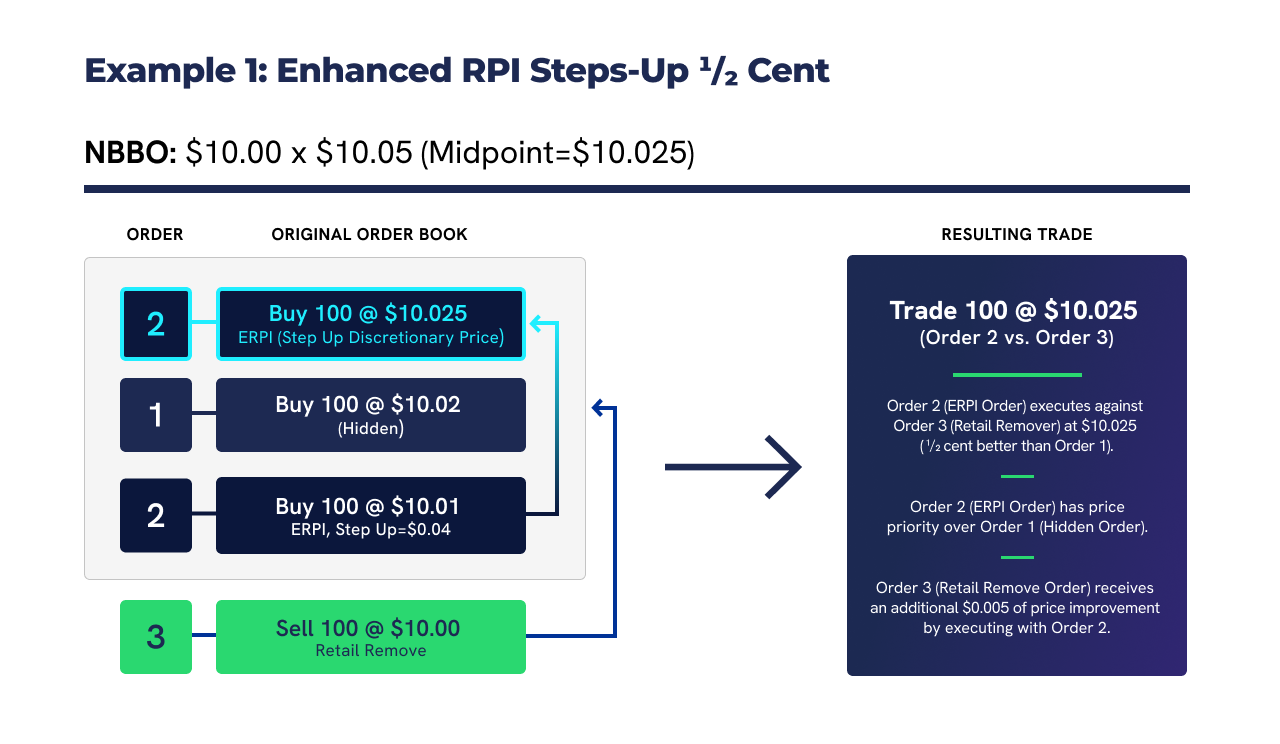
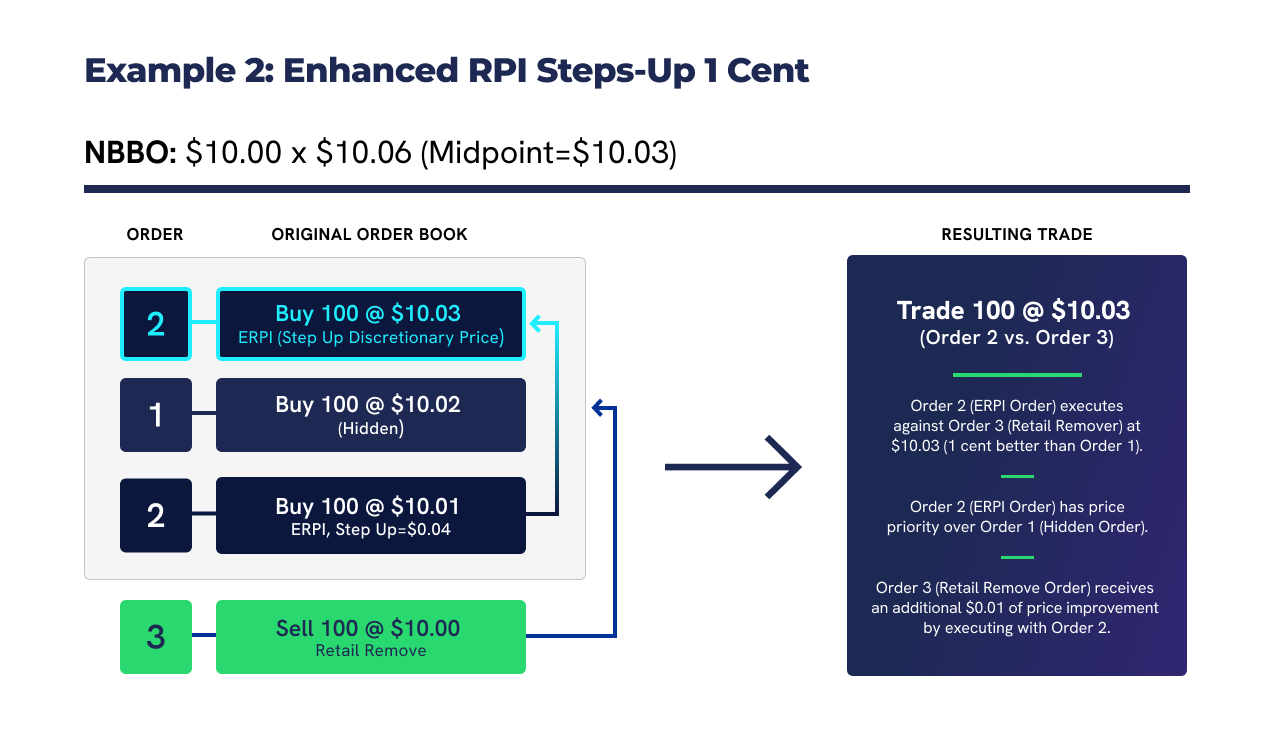
The Enhanced Retail Price Improvement (EPRI) instruction is an enhancement on the base
RPI order that enables RPI liquidity providers to post a limit order with a Step-Up
Range that will only be used when necessary to gain a higher queue priority, relative to
better priced orders on the BYX book. ERPI orders can receive higher price priority than
resting limit orders when executing against an incoming Retail Order at a price within
the designated Step-Up Range. The ERPI order increases fill rates for liquidity
providers and provides increased price improvement to retail investors.
How it Works
-
Retail Price Improvement (RPI) Orders are submitted by liquidity adders that
offer price improvement over the National Best Bid or Offer (NBBO) in minimum $0.001
increments. RPI orders only interact with Retail Orders.
-
A Retail Liquidity Indicator (RLI) message will be disseminated on PITCH and
SIP feeds when there is a Retail Price Improvement (RPI) order present for a symbol
on the BYX Exchange order book or to indicate a RPI order is no longer available.
-
When marketable retail-attested orders are submitted, participants can choose
from three types of interactions:
- Interact with Price Improving Orders Only (book only)
- Interact with Price Improving Orders and the far touch (book only)
-
Interact with Price Improving Orders, the far touch and route out (routable)
-
Enhanced RPI Orders are limit orders submitted by liquidity providers that
include a user-defined Step-Up Range, which is activated when an incoming Retail
Order will trade with a better-priced limit order. The ERPI order price improves
beyond the highest-ranked resting order and executes against the incoming Retail
Order.
-
For securities priced at or above $1.00, the ERPI order must step up to the next
half-cent midpoint or next full cent. For securities priced below $1.00, the
order must step up to the next minimum price increment. If there are no resting
orders with a higher priority ahead of a resting ERPI order, the ERPI order will
execute at its limit price.
Examples
Technical Information
Retail Price Improving (RPI) Orders
Any BYX Exchange Member may enter RPI orders in $.001 increments. RPIs are only accessible to Retail Orders.
No other order type will interact with an RPI order.
RPIs may be entered in $0.001 increments by any BYX Exchange Member as follows:
-
Retail Price Improving order:
- Must set RoutingInst (9303) = ‘B’ or ’ P’
- Must set ExtendedExecInst (9416) = ‘T’ (Retail Price Improving order)
-
DisplayIndicator (9479) = ‘I’ is implied but, like peg orders, not required;
any other values for DisplayIndicator will be rejected.
-
Retail Price Improving Peg order:
- Must set RoutingInst (9303) = ‘B’ or ’ P’
- Must set ExtendedExecInst (9416) = ‘T’ (Retail Price Improving order)
- Must set ExecInst (18) = ‘R’ (Primary Peg)
- Must set PegDifference (211). Price may be in 0.001 increments.
-
DisplayIndicator (9479) = ‘I’ is implied but, like peg orders, not required;
any other values for DisplayIndicator will be rejected.
-
Enhanced Retail Price Improving order:
- Must set RoutingInst (9303) = ‘B’ or ’ P’
- Must set ExtendedExecInst (9416) = ‘T’ (Retail Price Improving order)
-
Must set StepUpAmount (25025), a determined price range that is
implicitly added to bid prices and subtracted from offer prices that is
specified in $0.001 minimum increments, with the minimum value being
0.000 (default) and the maximum value being 99.999.
-
DisplayIndicator (9479) = ‘I’ (Invisible) is implied but, like peg orders,
not required; any other values for DisplayIndicator will be rejected.
Retail Orders (ROs)
ROs may only be entered by RMOs who have certified for the order type. ROs will access
price-improving liquidity in strict price/time priority as follows:
-
ROs may interact with both RPI orders as well as other price improving hidden
liquidity (i.e. midpoint pegs).
ROs may receive price improvement at multiple price levels.
- ROs will then access displayed interest as well as hidden interest at the NBBO.
- ROs may then route.
Retail Orders may be entered by Retail Member Organizations in $0.01 increments as
follows:
-
Retail Order – Type 1 – Price Improvement Only (Only access Price Improvement
orders.)
-
Must set ExtendedExecInst (9416) = ‘P’ (Retail Order – Price Improvement
only)
- Must set TimeInForce (59) = ‘3’ (IOC)
- Must set RoutingInst (9303) = ‘B’ (Book Only)
-
Retail Order – Type 2 – Book Only (Access Price Improvement orders up to the
limit price and access any liquidity available on Cboe at the limit price.)
- Must set RoutingInst (9303) = ‘B’
- Must set ExtendedExecInst (9416) = ‘R’ (Retail Order)
- Must set TimeInForce (59) = ‘3’ (IOC)
-
Retail Order – Type 2 – Routable (Access Price Improvement orders up to the
limit price and access any liquidity available on Cboe at the limit price. Then
route out at the limit price.)
-
RoutingInst (9303) and ExecInst (18) may be any combination of currently
accepted values for routing purposes
- Must set ExtendedExecInst (9416) = ‘R’ (Retail Order)
- Must set TimeInForce (59) = ‘3’ (IOC)
BYX RPI Performance
Retail-attested orders receive an average of $0.86 for 100 shares of price improvement
when executing against Price Improvement orders.
| PRICE IMPROVEMENT: BYX RPI PROGRAM (11/01/25 – 01/31/26) |
|
Average Price Improvement / 100 shares |
Symbol Count |
| Tape A |
$0.0142 |
2,025 |
| Tape B |
$0.0023 |
2,480 |
| Tape C |
$0.0050 |
3,410 |
| Overall |
$0.0043 |
3,410 |
Market Data - Retail Liquidity Indicator on PITCH and SIP Feeds
The Retail Price Improvement message is available on both the EDGX and BYX Exchange.
This message is a Retail Liquidity Indicator (RLI) that includes symbol and side, but
not price and size. An RLI will be disseminated when there is a Retail Price Improving
(RPI) order present for a symbol on the Exchange order book or to indicate a RPI order
is no longer available. RPI orders offer price improvement in increments of $.001 to
Retail Member Organizations. For ERPI orders, the existing RPI indicator on SIP and
proprietary feeds will be activated by the ranked price (limit price) of the ERPI order;
the Step-Up Range will not trigger the indicator.
| Retail Price Improvement |
| Field Name |
Offset |
Length |
Data Type |
Description |
| Timestamp |
0 |
8 |
Timestamp |
TimeStamp |
| Message Type |
8 |
1 |
"R" |
"Retail Price Improvement" message |
| Stock Symbol |
9 |
8 |
Printable ASCII |
Symbol |
| Retail Price Improvement |
17 |
1 |
Alpha |
• "B" = Buy Side RPI
• "S" = Sell Side RPI
• "A" = Buy & Sell RPI
• "N" = No RPI
|
Contact
Please contact the Cboe U.S. Equities Trade Desk ([email protected], 913.815.7001) or your
Director of Sales with any questions. We appreciate
your continued support of Cboe and look forward to earning more of your business.
Resources